Skip to content

Ground conditioning

The test is timed.
Train that way.

Morning and evening ground sessions built around the distances, repetitions and stations each service actually measures — from the 1.6 km run to the 5 km physical efficiency test.

1.6 km

Agniveer & Coast Guard

4.8 km

State police SI & constable

5 km

SSC GD constable

Training modules

Six disciplines on the ground.

Each module is scheduled against a specific test station. Open a module to see how it is trained.

Session emphasis92%

Progressive timed running built around the exact distances used by each service — 1.6 km for Agniveer and Coast Guard entries, 5 km for SSC GD, and 4.8 km for state police.

  • Base-building easy runs with a weekly timed effort
  • Distance-specific pace work for 1.6 km, 2.4 km, 4.8 km and 5 km tests
  • Recovery discipline between morning and evening ground sessions
Session emphasis80%
Session emphasis74%
Session emphasis68%
Session emphasis62%
Session emphasis58%

Emphasis percentages describe how the academy weights each discipline within its session template. They are not a measure of any candidate's fitness.

Fitness protocols

What each service tests.

Physical efficiency standards exactly as stated in the academy's reference guide. Where a service publishes no distance in the guide, none is shown.

Physical fitness test protocols by force
Force / entryStageComponents
Indian Army AgniveerPhysical Fitness Test
  • 1.6 km run
  • Pull-ups
  • 9-ft ditch
  • Zig-zag balance
Agniveer VayuPhysical Fitness Test
  • 1.6 km run
  • Push-ups
  • Sit-ups
  • Squats
Indian Navy AgniveerPhysical Fitness Test
  • 1.6 km run
  • Squats
  • Push-ups
Indian Coast GuardStage-II PFT
  • 1.6 km run in 7 minutes
  • 20 squats
  • 10 push-ups
SSC GD ConstablePET
  • 5 km run in 24 minutes (males)
  • 1.6 km run in 8.5 minutes (females)
  • Physical Standard Test
UP Police Sub-InspectorPET
  • 4.8 km run in 28 minutes (males)
  • 2.4 km run in 16 minutes (females)
  • Document verification & PST
UP Police ConstablePET
  • 4.8 km run in 25 minutes (males)
  • 2.4 km run in 14 minutes (females)
  • Document verification & PST

Eligibility, physical standards, syllabus and selection stages summarised on this website are compiled from a reference guide and are subject to change. Always verify against the latest official notification issued by UPSC, the Ministry of Defence, the Indian Armed Forces, SSC, the National Testing Agency or the relevant state recruitment board before applying.

Training estate

Ground, track and equipment.

Every station below exists because a service measures something at it. Dimensions and equipment inventories are confirmed at the campus visit; the plates show what each environment is set up to do.

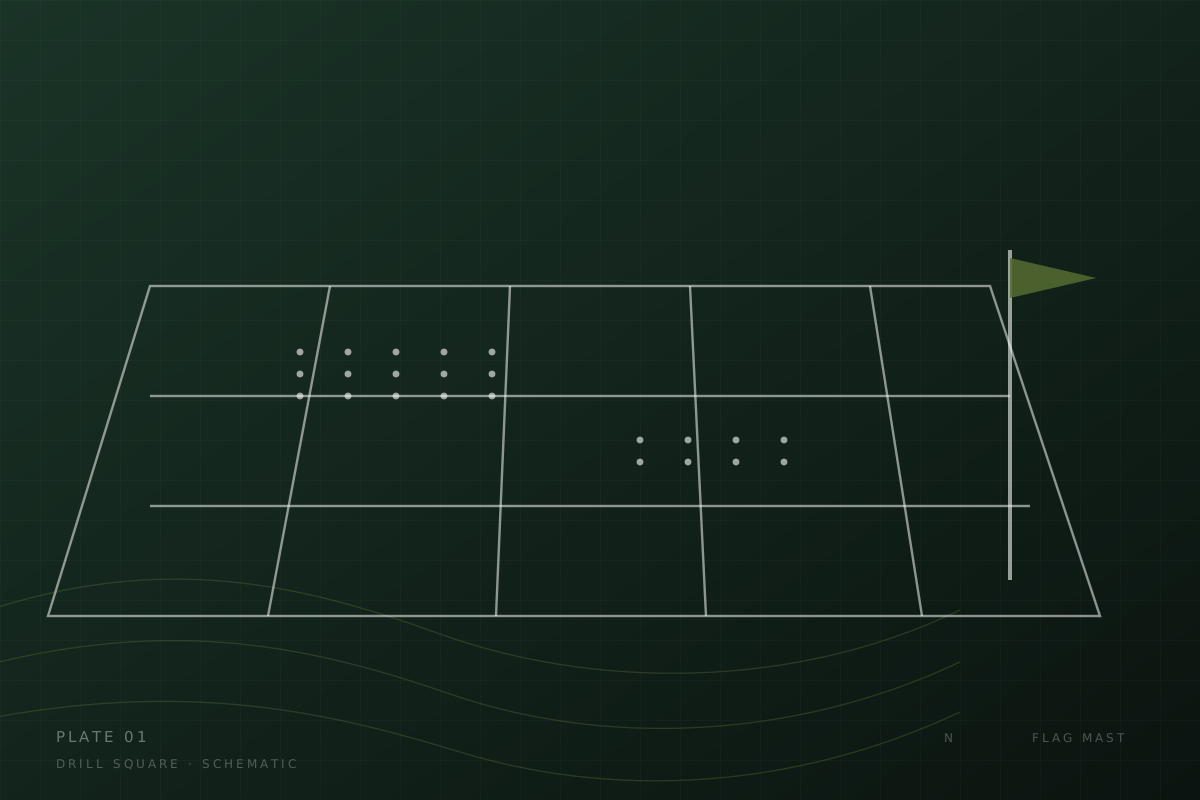
Drill square & parade ground — schematic plateDisciplinePlate 01

Drill square & parade ground

The square is the first place a candidate learns how a batch moves together. Assembly, roll call, marching and inspection practice all run here before the academic day begins.

  • Marked drill and assembly area
  • Formation, marching and inspection practice
  • Morning assembly and roll call
  • Flag mast for daily ceremonies
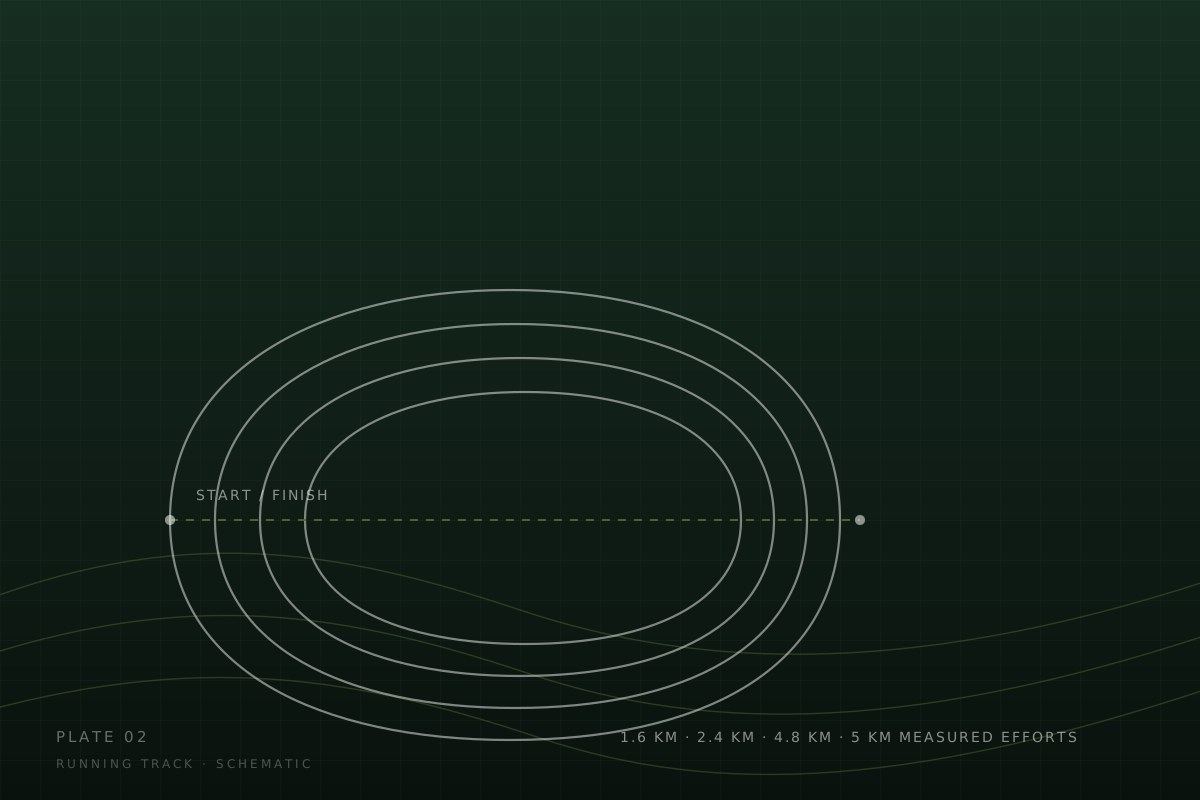
Measured running track — schematic plateEndurancePlate 02

Measured running track

Endurance is trained at the distance the candidate will actually be tested on. A measured loop with marked splits lets an instructor set pace work for a 1.6 km effort and a 5 km effort on the same ground.

  • Measured loop with distance splits
  • Separate pace work for 1.6 km, 2.4 km, 4.8 km and 5 km
  • Weekly timed effort under test conditions
  • Warm-up and cool-down lane
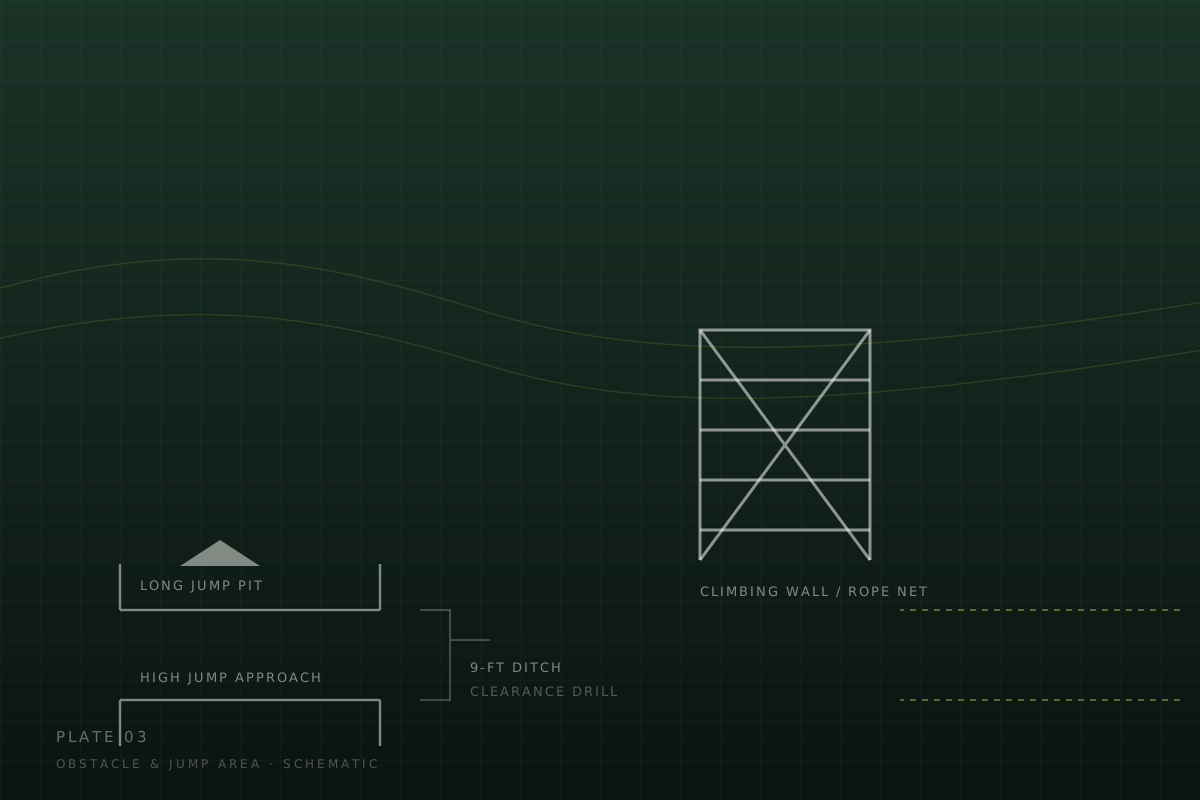
Obstacle, ditch & jump area — schematic platePower & agilityPlate 03

Obstacle, ditch & jump area

Jump and obstacle stations are trained separately, then sequenced into a timed circuit so the candidate meets them tired rather than fresh — the way a physical efficiency test does.

  • Long jump pit with measured take-off board
  • High jump approach and landing area
  • 9-ft ditch clearance drill
  • Zig-zag balance marking
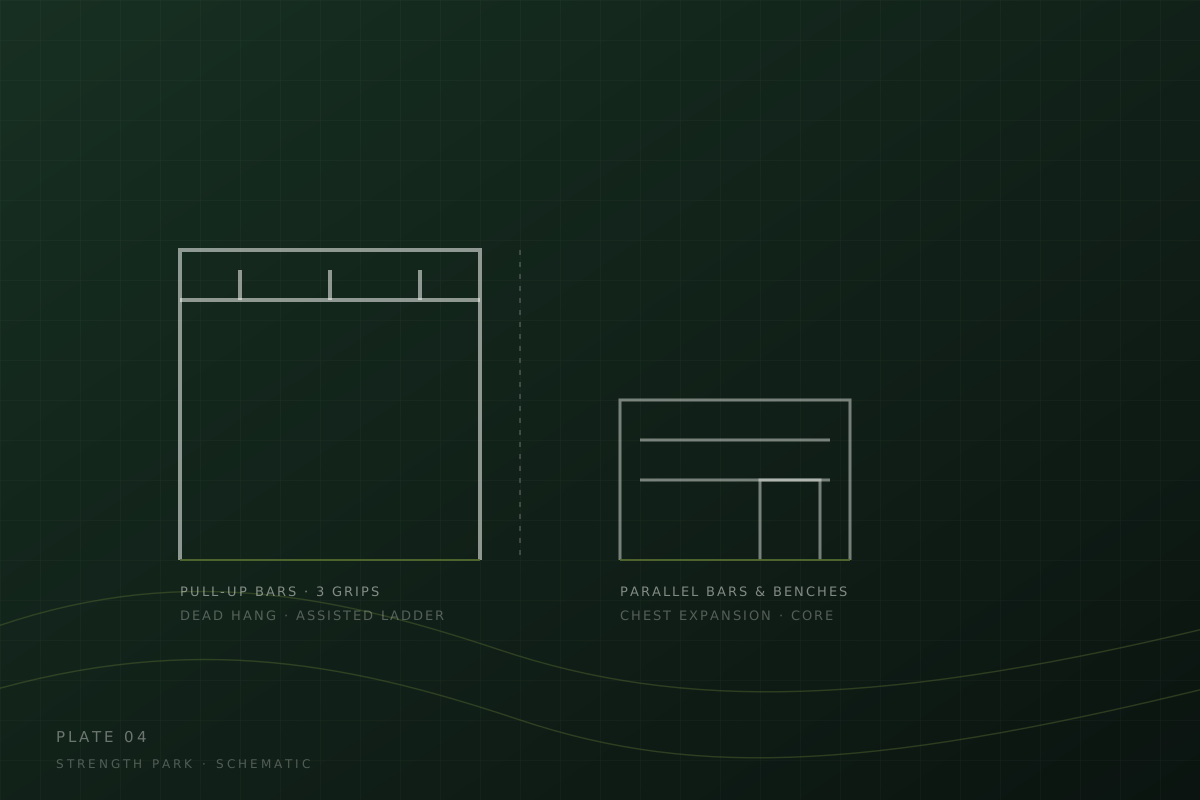
Strength & pull-up park — schematic plateStrengthPlate 04

Strength & pull-up park

The Army Agniveer fitness test scores pull-ups directly after the 1.6 km run. Strength work is therefore scheduled as its own station, with assisted and negative repetitions for candidates starting from zero.

  • Pull-up bars with multiple grips
  • Parallel bars and sit-up boards
  • Assisted and negative repetition setup
  • Chest-expansion and posture routine
Screening & measurement room — schematic plateScreeningPlate 05

Screening & measurement room

A private room for the preliminary checks taken at admission: height, weight, chest expansion, posture, eyesight and colour vision. Findings are recorded against the target entry and discussed with the candidate.

  • Height scale and weighing scale
  • Chest measurement with expansion check
  • Eyesight assessment against the 6/6 reference
  • Colour vision screening plates
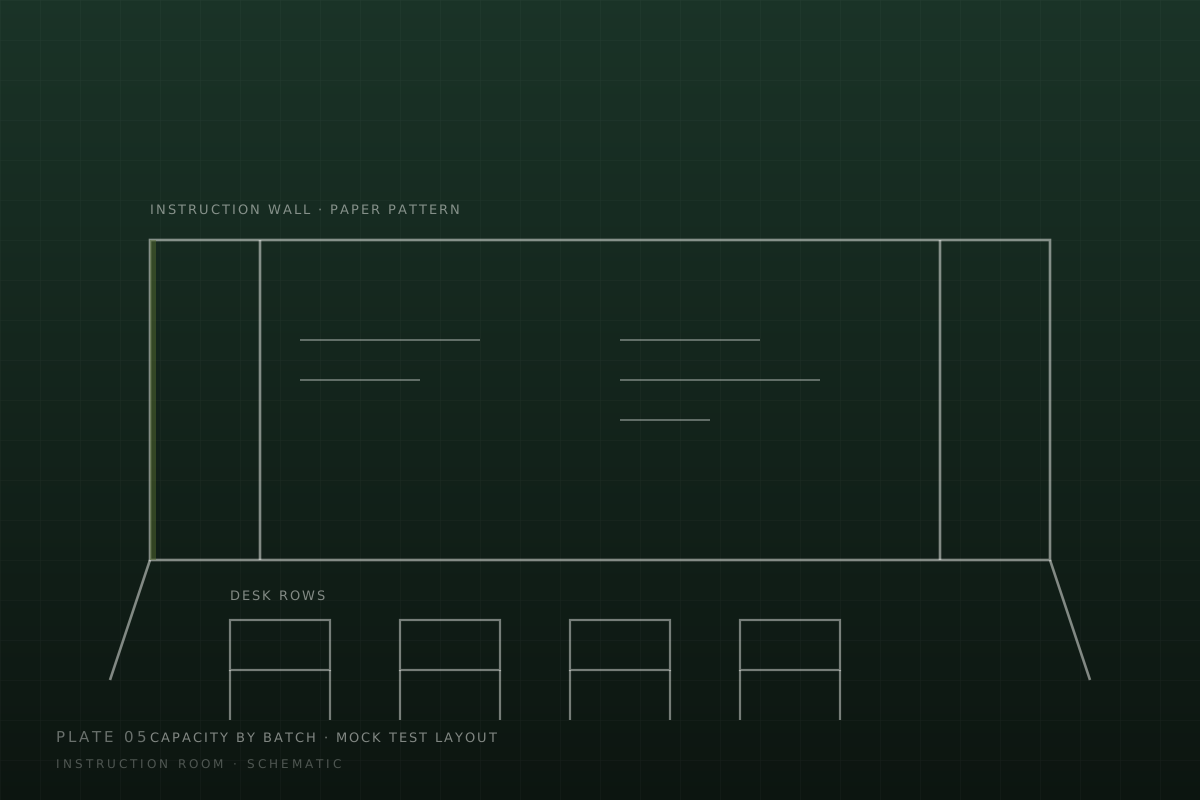
Briefing & recovery zone — schematic plateRecoveryPlate 06

Briefing & recovery zone

Session briefings, stretch and recovery work sit between the two ground sessions. Timed test simulations are briefed here so every candidate knows the sequence, station order and cut-off before it starts.

  • Session briefing board and station order
  • Stretch and mobility area
  • Hydration point
  • Post-session review with the instructor

Equipment lists describe the standard the training programme requires at each station. The academy publishes a facility only once it is available to a batch, and the admissions office confirms the current campus provision before enrolment.

Daily schedule

A day on the ground and in class.

An indicative training day. Timing shifts with the season and with the target entry; the sequence of ground, academic and interview work does not.

Morning and evening ground, daily
  1. 04:30

    Wake-up call & freshen-up

    Bed-making with hospital corners, room tidying, a glass of lukewarm water and a kit check before the parade ground.

  2. 05:00 – 06:45

    Morning PT & ground drills

    1.6 km or 5 km endurance running, warm-up, pull-ups, push-ups, sit-ups, obstacle course and stamina drills.

  3. 06:45 – 07:45

    Bath, turnout & breakfast

    Shower, change into the academy classroom uniform, and the morning mess breakfast.

  4. 08:00 – 08:15

    Assembly & current affairs

    Parade fall-in, national anthem, uniform inspection and the daily headline and defence-news quiz.

  5. 08:15 – 13:15

    Classroom academic sessions

    Four lectures on the core syllabus — mathematics, English, general studies and science, reasoning or Hindi — with a 15-minute mid-break.

  6. 13:15 – 14:30

    Lunch & afternoon rest

    A balanced meal in the mess followed by quiet rest in the hostel or rest lounge.

  7. 14:30 – 16:00

    Doubt clearing, SSB & spoken English

    OIR practice, PPDT / TAT / WAT workshops, group discussions, lecturettes and Hindi-to-English fluency drills.

  8. 16:15 – 17:45

    Evening sports & GTO tasks

    Team games — football, basketball, volleyball — long and high jump, rope climbing and chest expansion drills.

  9. 18:00 – 19:30

    Wash-up & supervised self-study

    Daily homework, daily practice problems, and vocabulary and formula revision.

  10. 19:30 – 20:30

    Dinner & night roll call

    Mess dinner followed by mandatory attendance roll call by the hostel warden.

  11. 20:30 – 22:00

    Night revision & kit preparation

    Newspaper notes, weak-topic revision, shoe polishing and laying out the PT kit for the morning.

  12. 22:15

    Lights out

    Complete silence in all dormitories, with a corridor and room check by duty staff.

Screening

Measured before it is trained.

Preliminary screening at admission so cadets are counselled into forces whose medical and physical criteria they can realistically meet.

01

Height measurement (barefoot)

Recorded against the minimum height for the target service, branch and category, including the hill-region relaxations stated in the guide.

02

Chest measurement & expansion

Unexpanded and expanded chest recorded; the minimum expansion is 5 cm, and Army Agniveer requires 77 cm plus 5 cm expansion.

03

Weight & BMI

Weight recorded with BMI, and a corrective diet and exercise plan where the reading is outside the target band.

04

Distant & near vision

Vision recorded eye by eye against the 6/6 unaided reference and the permissible limits for the target branch.

05

Colour vision (Ishihara)

Screened against the CP-II / CP-III standard; red-green deficiency restricts several branches and trades.

06

Knock knees (genu valgum)

Inter-malleolar gap assessed with the knees together; a gap under 5 cm is the benchmark for a clear result.

07

Bow legs & flat foot

Plantar arch and tibial alignment observed, with no bowing recorded for a clear result.

08

Carrying angle (elbow)

A carrying angle of 10°–15° is normal; cubitus valgus beyond that range is flagged for review.

09

Spine & scoliosis

Spinal alignment checked for straight posture, with no kyphosis or scoliosis recorded.

10

Varicose veins & tremors

Leg veins examined for tortuosity and outstretched hands checked for tremor.

11

ENT & dental points

Tympanic membrane checked and dental points recorded against the minimum of 14.

12

Permanent body tattoos

Tattoos are permitted only on the inner forearm or the dorsum of the hand; anything else is flagged.

13

Past surgery & chronic illness

History of asthma, epilepsy, hernia, hydrocele or fractures is recorded for the service medical board.

Guidance, not certification

Pre-admission screening is preliminary guidance only. It is not an official medical fitness certification, and it does not guarantee eligibility, selection or appointment.

Book a screening

Programs

Ground conditioning is part of every soldier batch.

Soldier & police track